

Did you maybe also ask yourself.... WHAT IS THE STRENGTH OF CONCRETE?
Actually the strength of concrete is just a definition. We make cubes or cylinders of concrete that we test in compression after 28 days. From the value that we get from these tests we get a number that we call the strength of concrete. With that number we are able to design impressive concrete structures, since the strength is the basic property where all our codes and design guidelines are based on.
The good news is: IT WORKS! We are able to create concrete structures that function and are also durable. It works because we have a lot of experience with the material CONCRETE and using it in structural design.
The question now is what is the 'strength' of greener concrete? And is the strength (testing a cube or cylinder after 28 days) still the right property for 'green concretes' when we make a structural design using the same design codes that are made for 'regular concrete'?
The answer most probably is NO!. The design codes for regular concretes are NOT valid for 'greener concrete', because we have NO experience yet.
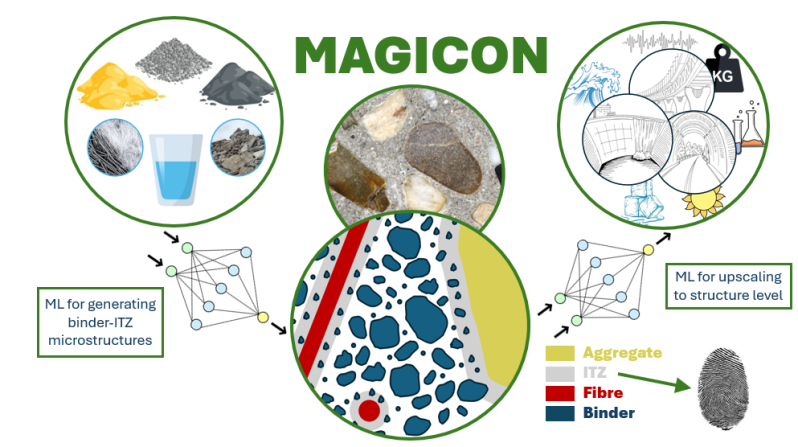
How do we define 'green concretes'? Let's say green concretes are concrete-like materials in which the ingredients are 'greener' than the ingredients in regular concrete. In short: the aggregates (plus sand and filler) and/or the binder can be completely different (with different properties) than in 'regular concrete'. (Think about recycled aggregates, binders without Portland Cement, natural fibres, biochar, PET-bottles, coral sand, algae, bacteria, clay, polymers ..... and whatever else is used to 'improve' concrete). It the ingredient in the green concretes stay close to those of regular concrete, then the 'strength' and other properties might not deviate that much. But the further we go away from our standard material (more green material), the more our properties will change. Furthermore we LACK EXPERIENCE with our new green materials. Our design codes will not be valid!
Another issue with 'greener concretes', is the way of construction. We try to build in the way we are used to. But these new materials often require a different way of mixing, casting, curing...etc. The 'properties' of the green material in your structure might be completely different from the properties that are measured in the lab. Also here we lack experience.
WHAT WILL MAGICON CHANGE?
MAGICON will focus on the 'connection' between the ingredients, the ITZ (interfacial transition zone) between aggregate particles (or sand and fibres) and the binder. We are not only going to characterize this ITZ with microscopy and CT-scanning, but we are also going to measure mechanical and transport properties on a micrometre scale. By combining experiments, computational modelling and AI with big data we will develop a new strategy to make it possible to design safely with our (future) green concretes.
MAGICON, an ERC-funded project will start in January 2026 to work on this. We were able to gather a group of enthusiastic and smart people for this (4 PhD's and 2 Postdocs).
You can see the team and the background of the project and you can follow the results that we will obtain on the project website (www.erc-magicon.eu)
If you made it, reading all the way to here, then finally MAGICON wishes wou happy holidays!!!!
Add comment
Comments